
The new U.S. Dietary Guidelines for Americans, announced last week, represent the most significant change to federal nutrition policy in the 45 years since the guidelines were first issued. The new policy isn't perfect, but it's a tremendous step forward. The pyramid has literally flipped, now featuring beef, butter, and full-fat dairy—the very foods that were discouraged for decades—while moving grains to the pyramid tip, where they belong. Sugars are absent from the pyramid altogether (they were formerly included as “sweets”), and, for the first time, a low-carbohydrate diet is included as an option for people with chronic diseases. The Nutrition Coalition advocated for most of these changes for years.
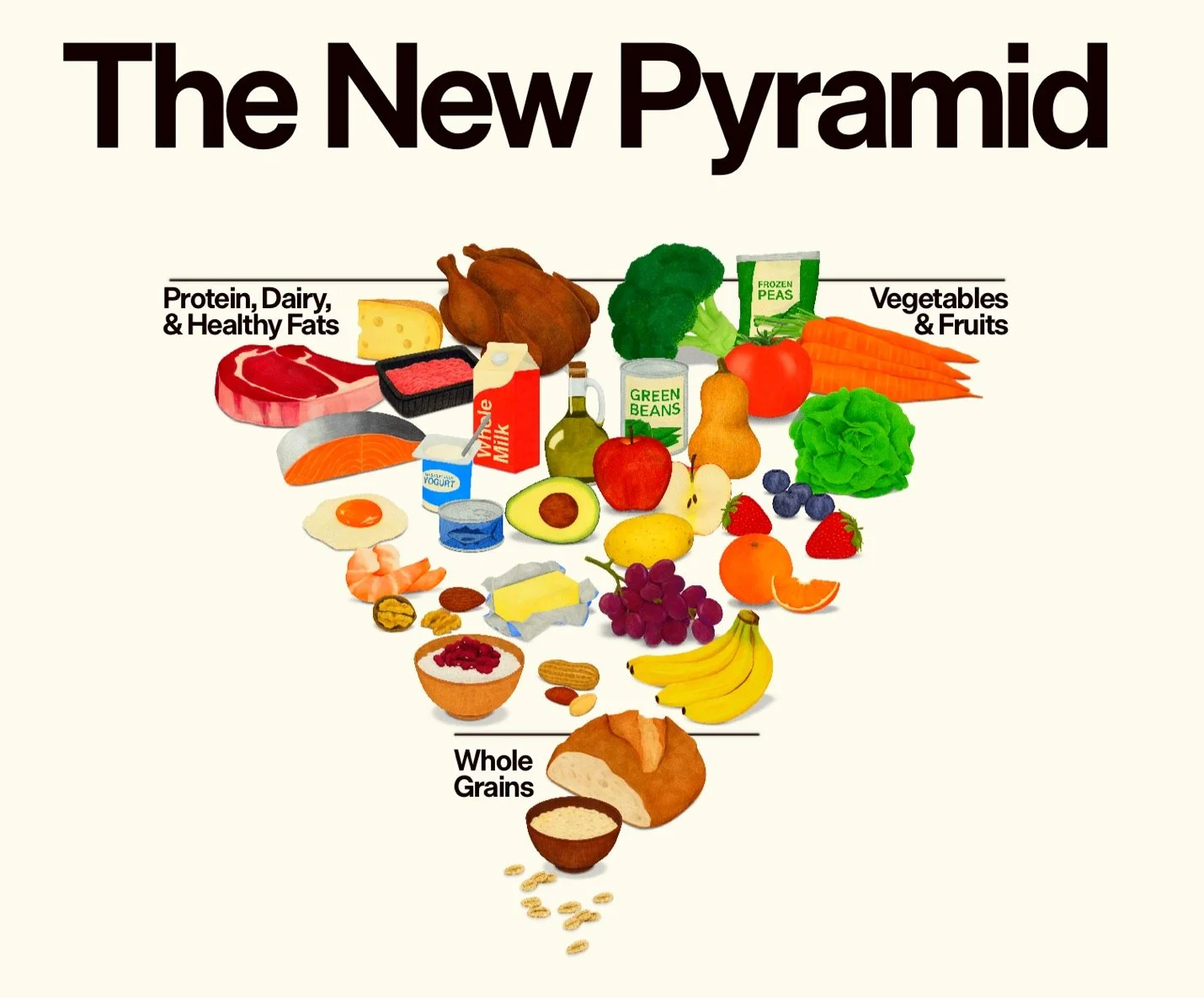
Here's a recap of the major changes in the new guidelines:
Increased Protein
Protein now holds a prominent place in the daily diet, to be prioritized "at every meal." Specifically, the daily recommended amount of protein has increased from 0.8 grams per kg of body weight to 1.2 to 1.6 grams. (Note: the guidelines should say "per ideal” kg of bodyweight to be accurate.) Adequate protein is not only important for building muscle—it's also essential for fighting illness, avoiding osteoporosis, and providing a feeling of fullness ("satiety") after meals, which helps reduce snacking and food cravings. Higher protein intake is particularly important for the elderly, who don't process protein as efficiently, and for growing children. The previous 0.8-gram standard was the minimum amount required to prevent malnutrition and wasting, but was insufficient for optimal health. I wrote a recent op-ed for the Wall Street Journal on this subject; the Nutrition Coalition also published a comprehensive article about declining protein standards in the guidelines and why they needed to be changed.
Grains Slashed
The big slab of cereals and bread at the base of the pyramid—formerly 6–7 servings per day—has been dramatically reduced to 2–4 servings. This may be the most under-reported change in the guidelines, since carbohydrate reduction has been shown to be a powerful way to reverse the toll of chronic diseases for many people.
A Low-Carbohydrate Diet Now Recognized
A low-carbohydrate diet is now included as a viable option for people with certain chronic diseases. Many of us have advocated for a low-carb option for years. We helped organize doctors and others to testify at meetings of the Dietary Guidelines Advisory Committee and urged officials to consider the importance of providing an alternative for the 93% of American adults with sub-optimal metabolic health who now represent the "general public" that the guidelines are, by law, meant to serve. These arguments resonated with officials at the U.S. Department of Health and Human Services (HHS), who led this iteration of the guidelines. Advocacy by the recently formed Coalition for Metabolic Health has no doubt also played an important role. The guidelines now—finally—provide an option for people with metabolic conditions. Low-carb can no longer be considered a "fad" diet—it is endorsed by the federal government, a historic step forward in the fight against chronic disease.
Added Sugars Reduced
There is broad consensus that excessive sugar consumption harms health. Michelle Obama deserves credit for helping to impose a 10%-of-calories limit on added sugars in the 2015 guidelines, but that limit remained unchanged for a decade. The new guidelines imposed a cap on added sugars of 10 grams per meal, which amounts to approximately 6% of daily calories a day (if no additional sugar comes from snacks). The new recommendations also advise zero added sugars for children up to age 10—a fantastic step forward.
Beef on the Menu
After decades of emphasizing "lean meat" (i.e., poultry), the guidelines now prioritize beef as a protein option. The thick slab of steak gleaming prominently atop the pyramid is a stunning message to the public that red meat is not only safe to eat--but should be emphasized. The science linking red meat to disease has relied entirely on epidemiological studies, which cannot reliably demonstrate cause-and-effect relationships. The most rigorous systematic reviews of red meat have not established a causal link to disease. This change is welcome and long overdue.
Butter and Tallow Included
Animal fats are now "healthy fats." Butter and beef tallow are mentioned by name; "full-fat" yogurt is encouraged. This change is also revolutionary. All previous editions of the guidelines included extensive warnings against saturated fats while emphasizing polyunsaturated vegetable oils (now called seed oils) as the preferred "added fats"—5½ teaspoons per day for the average person.
Major caveat: A notable disappointment is that the guidelines kept the 10%-of-calories cap on saturated fats—a decision that may have been influenced by political considerations. This limit makes consuming butter, tallow, and fatty cuts of red meat virtually impossible if you're abiding by it. While the average person can follow the new food pyramid and ignore the 10% cap, those in captive institutional settings cannot. Kids eating school lunches, members of the military, and vulnerable populations receiving federal food assistance will still get lean meat cooked in seed oils, as all federal programs are required by law to follow these guidelines. This reality will be hard to change for the next five years, until the next guidelines are issued in 2030. So, in my view, this 10% cap remains the most significant disappointment in these guidelines.
For policy wonks, here are a few more changes that are highly significant yet have received less attention:
Clarity on Dietary Cholesterol
We've had an endless back-and-forth over whether the cholesterol in eggs and shellfish causes heart disease. Unknown to most people, the guidelines were in large part responsible for this confusion. Although the 2015 guidelines dropped any formal numeric cap on cholesterol, the guidelines—paradoxically — still stated that healthy dietary patterns were "lower in cholesterol." These conflicting messages sent mixed signals. The current guidelines ditch any warnings about dietary cholesterol, which provides needed clarity and should be the final word on this long-debated topic.
End of Low-Fat Diet (for most!)
Since 2015, the guidelines have backed off using any "low-fat diet" language, acknowledging in the expert report that it can raise the risk for heart disease. However, the 2015 and 2020 guidelines adopted dietary fat standards defined by the National Academies of Sciences, known as the "Acceptable Macronutrient Distribution Ranges" (AMDR), which allow dietary fat to range from 20% to 35% of calories — effectively maintaining a low-fat framework. The new guidelines do not mention "low fat" or any percent limit. Is this finally the end of the low-fat diet recommendation? We hope so.
Caveat: In a technical "Daily Servings" guide published with the new guidelines, the amount of added fat is listed as only 4.5 teaspoons daily for a 2,000-calorie-a-day diet. That's less than the 5.5 teaspoons in the 2020 guidelines. It's possible that more fat could be added via the natural fats in proteins, now encouraged in larger amounts. Yet again, with the 10% cap on saturated fats, those proteins in institutional settings will necessarily be lean meat (skinless poultry), beans, legumes, or peas, with little or no fat. Federal programs are therefore likely to continue to follow a relatively low-fat approach. On the positive side, the added fat is now listed in "Daily Servings" as coming from olive oil or butter, not seed oils.
No Mention of Seed Oils
All previous guidelines promoted polyunsaturated vegetable oils as the preferred added fat. The new guidelines do not include any language on seed/vegetable oils or polyunsaturated fats. While many of us had expected some warning about these fats, given the anti-seed-oils rhetoric so prevalent in the administration, the absence of any mention is still a step forward.
Warning on Vegetarian/Vegan Diets
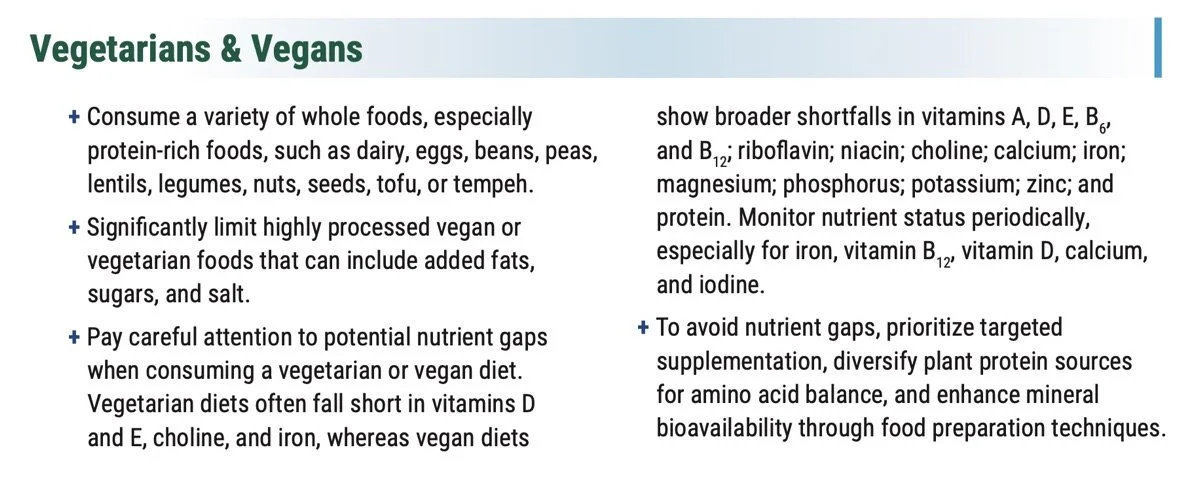
The new protein-centric guidelines eliminated the "vegetarian dietary pattern" from the 2015 and 2020 guidelines. The new, 9-page guidelines go even further with a full half-page section warning about the lack of essential nutrients in vegetarian and vegan diets. Some of this information had been present but buried in the 100+-page previous editions of the guidelines. It's good to see this critically important information for people following these diets.
The Nutrition Coalition advocated for many of these changes. We promoted the science on saturated fats and low-carbohydrate diets. Above all, we raised awareness among the general public and scientific community about the need to reform the guidelines. A major reason HHS could move forward with such dramatic changes is that we secured Congressional funding for two major reports on the guidelines by the National Academy of Sciences, Engineering, and Medicine, authoritative documents that helped legitimize the reform.
There's no doubt that these guidelines mark a historic turning point — one we hope will be preserved and advanced in future editions. None of this could have happened without supporters of the Nutrition Coalition. Over the years, you've written letters, called your elected officials, rallied on social media, and donated generously. Thank you! This is our collective victory.